Have you ever tried drawing a perfect circle and ended up with something that looked more like an oval in disguise? You’re not alone! Even great mathematicians struggled before discovering the circle of Apollonius, one of the most fascinating and elegant ideas in geometry. This ancient concept shows how mathematics, art, and accuracy beautifully connect.
But here’s the fun twist: you don’t need to be a math genius to enjoy it. Whether you’re a student curious about geometric wonders or someone who loves playful accuracy challenges, learning the circle of Apollonius can actually be fun. It helps you understand balance, precision, and creativity all while giving your brain a joyful workout. Ready to master geometry fast? Let’s dive into the magic of circles and discover why this one is truly special!
What Is the Circle of Apollonius?
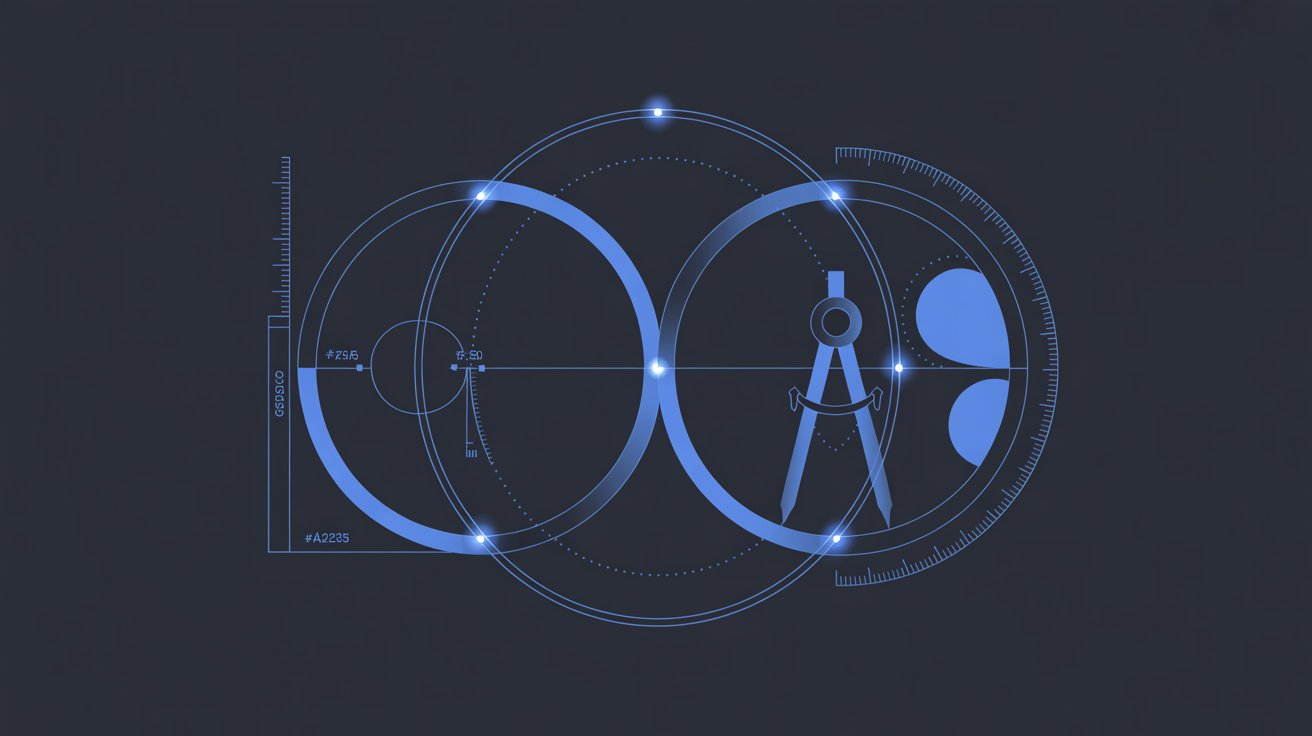
The circle of Apollonius is a unique geometric curve that represents all the points having a constant ratio of distances from two fixed points. Sounds a bit complex? Don’t worry, think of it like this: imagine two points on a page, A and B. If you find all the spots where the ratio of your distance to A and B remains the same, you’ll end up drawing a perfect circle. That’s the Apollonius magic!
Named after Apollonius of Perga, a brilliant ancient Greek mathematician known for his work on conic sections, this concept combines logic with visual beauty. It’s not just about equations, it’s about understanding how symmetry and ratios shape the world around us.
Why Geometry Students Love the Circle of Apollonius
Geometry isn’t just about memorizing formulas, it’s about visual thinking, logic, and creativity. The circle of Apollonius offers a hands on way to grasp geometric ratios while having fun. Here’s why students and creators enjoy exploring it:
- It’s visually satisfying. Watching a circle emerge from pure ratios feels magical.
- It sharpens problem solving skills. You learn to think in spatial relationships.
- It connects math to art. Circles appear in design, symmetry, and architecture.
- It boosts focus. Drawing perfect circles by hand improves your motor skills and concentration.
- It makes learning playful. Geometry suddenly feels like a creative game!
As one geometry teacher, Dr. Lena Vass, puts it:
“The circle of Apollonius is one of those rare mathematical gems where accuracy meets art. It teaches students that geometry isn’t about numbers, it’s about seeing balance.”
How to Visualize the Circle of Apollonius (Step by Step)
Here’s a simple way to understand how this circle forms and how you can experiment with it using your circle drawing tool:
- Mark two points on your screen or paper and call them A and B.
- Pick a ratio, say 2:1. This means every point on the circle will be twice as far from A as from B.
- Use your circle tool to plot points that follow this rule.
- Watch as those points connect into a perfect circle!
You’ve just created a circle of Apollonius congratulations!
Now, to make things fun, challenge yourself:
Can you draw it by hand and get within 90% accuracy on the Draw a Perfect Circle Tool?
The Psychology Behind Circles and Learning
Circles have a calming and satisfying effect on the brain. Studies in cognitive psychology show that drawing smooth, continuous shapes like circles improves focus and lowers stress levels. The circle of Apollonius, with its logical beauty, provides the perfect mix of structure and creativity.
When you attempt to draw or visualize this circle, your brain activates areas linked to pattern recognition, spatial reasoning, and fine motor control. This combination makes the learning process enjoyable and memorable.
“Circles symbolize unity, perfection, and balance the same qualities we strive for in creative thinking,” says Dr. Maya Chen, a psychologist who studies art based learning.
My Funny Circle Experience (and What It Taught Me)
Here’s a personal confession the first time I tried to draw the circle of Apollonius, it looked like a lopsided doughnut! My ratio was completely off, but that’s when I learned something valuable: perfection isn’t the goal; progress is.
Once I used the Draw a Perfect Circle Tool, I could finally see my ratio align correctly. The tool’s feedback score motivated me to keep improving. After a few tries, my circle accuracy jumped from 67% to 92%! The secret? Steady hand, deep breaths, and a playful mindset.
So, don’t worry about getting it right the first time. Every attempt teaches your hand and mind to sync better. That’s the real magic of geometry!
Real World Examples: Where You’ll See the Circle of Apollonius
This isn’t just theory the circle of Apollonius shows up everywhere:
| Field | Real Life Application |
| Navigation | GPS and triangulation systems use similar distance ratios to locate positions. |
| Art & Design | Artists use circle ratios to create balanced compositions. |
| Physics | Wave interference patterns often follow Apollonius style curves. |
| Architecture | Symmetrical domes and circular arches rely on geometric ratios. |
Even modern 3D design software includes ratio based geometry tools that echo Apollonius’ principles proving that a concept from 2000 years ago still shapes the creative world of today.
Interactive Challenge: Can You Beat the Circle Tool?
It’s time for a fun geometry challenge! Open the Draw a Perfect Circle Tool, and see how close your freehand circle can match perfection.
Then take it a step further:
- Try drawing two fixed points (A and B).
- Pick a ratio (e.g., 1.5:1).
- Attempt to form the circle of Apollonius freehand.
Your mission? Beat the 85% accuracy score. Share your results with friends or post your circle online. It’s a geometry meets game moment worth bragging about!
Not only will you improve your hand precision, but you’ll also feel the geometry as you draw.
Quick Geometry Tip
Here’s a trick for smoother results:
👉 When drawing freehand, keep your wrist relaxed and rotate your arm from the shoulder. This maintains consistent curvature, a secret used by artists and architects alike.
The Apollonius Advantage: Learn, Create, and Have Fun
The circle of Apollonius is more than a mathematical idea; it’s a way to see geometry as a creative adventure. You’ll master spatial logic, ratios, and symmetry faster when you connect the concept with hands on tools and playful experiments.
So whether you’re preparing for a test, exploring art, or simply love challenges, the Apollonius circle is your gateway to smarter and more enjoyable learning.
Conclusion: Draw. Learn. Share.
Geometry doesn’t have to be dull; it can be your next creative playground. The circle of Apollonius proves that logic and art are best friends. Use the Draw a Perfect Circle Tool to practice, challenge yourself, and see how close you can get to perfection.
Try it now, share your score, and explore more circle challenges on our blog. You’ll be amazed how fast your geometry skills and creativity grow!
FAQs About circle of apollonius
What is the circle of Apollonius?
It’s the set of points where the distances to two fixed points have a constant ratio. Simply put, it’s a special kind of circle discovered by Apollonius of Perga.
Why is the circle of Apollonius important?
It helps in understanding ratios, distances, and geometric symmetry foundations for art, architecture, and even navigation systems.
How can I draw the circle of Apollonius easily?
Use the Draw a Perfect Circle Tool or digital geometry software. Start with two fixed points and maintain your chosen ratio to see the circle form.
Can I use this concept for creative projects?
Absolutely! Designers and artists use Apollonius circles to create balanced compositions and smooth curves.
Is drawing the circle of Apollonius hard?
Not at all! It takes a few tries, but with patience and tools like our circle challenge, you’ll master it faster and have fun along the way.