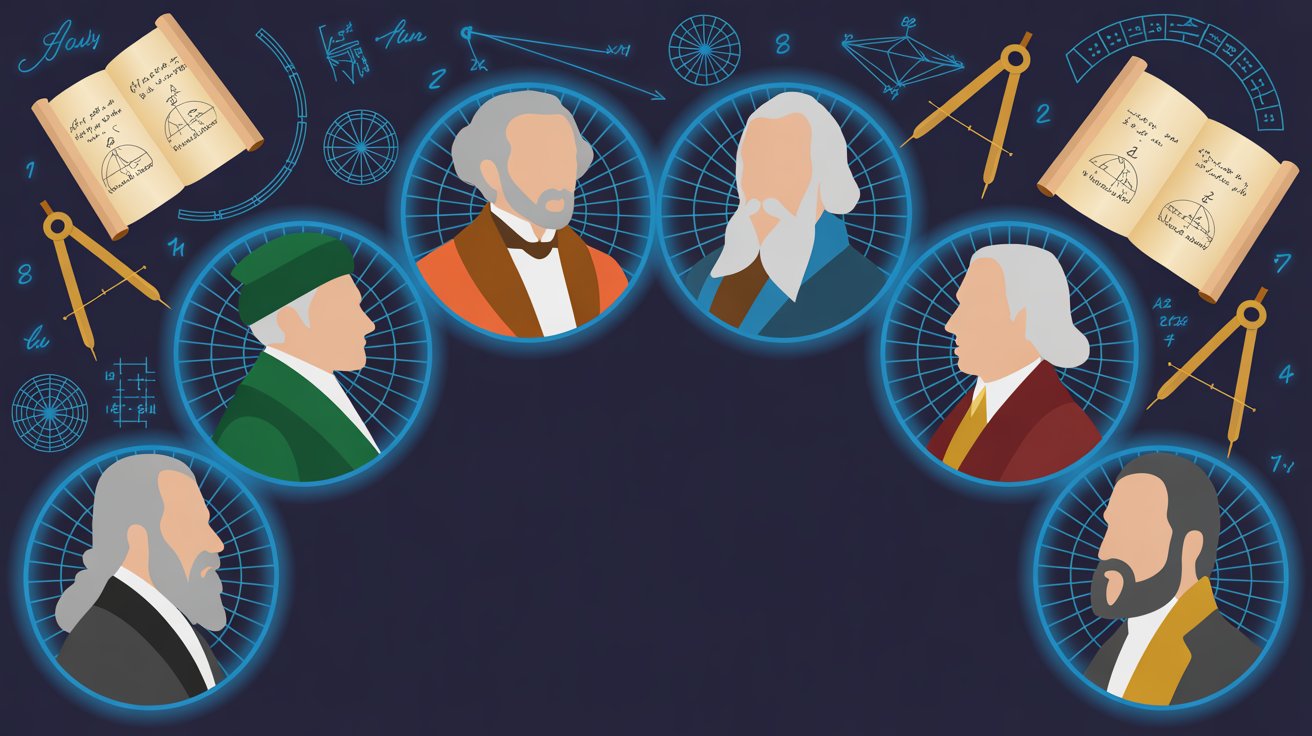
Did you know that some of the greatest mathematicians who studied circles changed the way we see art, design, and even life itself? It’s true! From the ancient Greeks who measured the heavens to modern scientists who use circles in computer graphics, this simple shape has always fascinated the brightest minds.
But here’s the twist: the circle isn’t just a shape; it’s a symbol of perfection, unity, and endless possibility. The more you learn about it, the more magical it gets! And if you’ve ever tried to draw a perfect circle by hand, you already know it’s harder than it looks. That’s exactly why so many mathematicians, artists, and even psychologists have obsessed over it. Let’s uncover the fun, genius, and creativity behind the mathematicians who studied circles, and see how their ideas still inspire the digital circle challenges we love today.
1. Why Circles Fascinated the Greatest Minds
From geometry to galaxies, the circle represents harmony and perfection. Many famous thinkers spent their lives exploring its mysteries not for fame, but out of pure curiosity.
Pythagoras, for example, believed the circle was the most divine shape in the universe because it had no beginning or end. Euclid later built entire chapters around its geometry in his book Elements, creating the foundation for modern math and design. Even Archimedes couldn’t resist the charm; his studies of the circle’s area and circumference became the roots of π (pi).
These brilliant mathematicians who studied circles weren’t just crunching numbers. They were decoding the language of beauty itself, the same beauty you feel when you finally nail that perfect digital circle on your screen!
2. The Golden Ratio and the Circle Connection
Have you ever heard of the golden ratio? This mathematical formula shows up in nature, art, and design and it’s deeply connected to the circle. The ratio (about 1.618) describes proportions that feel naturally pleasing to the human eye.
Leonardo da Vinci, inspired by Greek mathematicians, used it to design masterpieces like The Vitruvian Man. Circles appear everywhere in that drawing from the body’s proportions to the overall balance.
Modern researchers, like psychologist Dr. Christopher Tyler, have shown that our brains are wired to prefer circular shapes. That’s why perfect circles feel satisfying and why using the Draw a Perfect Circle Tool can become so addictive. It’s a modern test of your sense of symmetry and focus just like ancient geometers experienced, only gamified for 2025!
3. From Chalkboards to Computer Screens: The Evolution of the Circle
The circle has gone from being drawn in sand by Greek philosophers to being plotted on high tech digital screens. Let’s take a fun look at how this evolution happened:
| Era | Mathematicians | Circle Use | Fun Fact |
| Ancient Greece | Euclid, Archimedes | Defined the properties of the circle | Archimedes discovered how to calculate π using polygons. |
| Renaissance | Leonardo da Vinci, Kepler | Blended geometry and art | Kepler described planetary orbits as “imperfect circles.” |
| Modern Age | Einstein, Ramanujan | Applied circles in physics and formulas | Einstein’s relativity relies on curved space, a circular concept! |
See how far we’ve come? The mathematicians who studied circles didn’t just define geometry; they built the bridge between art, science, and creativity that we walk on every day.
4. Personal Circle Challenge: My “Almost Perfect” Moment
Okay, confession time. The first time I tried the Draw a Perfect Circle Tool, my score was a sad 63%. I thought my steady hand was unbeatable until I saw that wobbly loop!
But here’s the fun part: after a few tries, I realized the secret isn’t speed, it’s rhythm. The trick is to relax your hand, focus on a smooth motion, and visualize the circle before you draw it. Within 10 minutes, I hit 88%!
That tiny win reminded me of the patience those mathematicians who studied circles must’ve had centuries ago. Each failed sketch or calculation wasn’t a mistake, it was part of the discovery. And the same goes for your circle drawing challenge today. Don’t chase perfection, enjoy the process.
5. What Modern Experts Say About Circles and the Mind
Geometry teacher Dr. Lila Greene explains it best:
“Drawing or studying circles activates both the logical and creative sides of your brain. It’s math, art, and mindfulness combined.”
In fact, a 2023 study by the Journal of Visual Perception found that people exposed to circular shapes showed 12% higher relaxation levels compared to angular shapes. That means circles aren’t just mathematically perfect they’re psychologically soothing too!
So next time you open the Draw a Perfect Circle Tool, remember: you’re not just testing hand control. You’re exercising creativity, geometry, and calm all at once.
6. The Circle as a Challenge and Meditation
Many psychologists call the act of drawing a circle a form of “dynamic meditation.” It focuses your mind, slows your breathing, and builds coordination. That’s why even monks in Tibet create circular mandalas as spiritual art circles connect the mind and motion.
The mathematicians who studied circles discovered that their equations often described natural calmness. From Kepler’s celestial orbits to Newton’s motion laws, the circle symbolized predictability in an unpredictable world.
Feeling inspired? Open the Draw a Perfect Circle Tool, take a deep breath, and aim for your best score yet. Can you beat 85% accuracy?
7. Fun Challenge: Beat the Mathematicians!
Let’s make this interesting. Imagine if Archimedes had today’s circle tool he’d probably spend hours testing his precision! You can do the same.
Here’s a quick 3 step challenge:
- Open the Draw a Perfect Circle Tool.
- Try drawing three circles in under 10 seconds each.
- Share your highest score with friends and see who’s the true circle master!
Remember, every great mathematician started with curiosity. You’re continuing their legacy one circle at a time.
8. Conclusion: Circles Unite Logic and Art
From Pythagoras to Einstein, the mathematicians who studied circles have shown us that geometry isn’t just about numbers it’s about balance, imagination, and joy. Their work still inspires our tools, challenges, and designs.
So the next time you pick up your mouse or stylus, channel your inner genius. Try our Draw a Perfect Circle Tool, share your score, and explore more fun geometry challenges on our blog. Who knows, maybe your name will be the next one added to the long list of circle loving thinkers!
Keep drawing. Keep learning. And most importantly keep it perfectly round.
FAQs About mathematicians who studied circles
Who were the most famous mathematicians who studied circles?
Some of the most famous include Euclid, Archimedes, Pythagoras, Kepler, and Einstein. Each contributed to how we understand the geometry and perfection of circles today.
Why did mathematicians study circles so much?
Because the circle symbolizes perfection, symmetry, and natural beauty. It helps explain everything from planets’ paths to the design of everyday objects.
How can studying circles help me in real life?
Understanding circles boosts spatial reasoning, focus, and creativity. Plus, using tools like the Draw a Perfect Circle Tool is a fun way to train precision and patience.
Are circles connected to psychology?
Yes! Studies show circular shapes make us feel calmer and more balanced. That’s why circles appear in meditation art, logos, and even architecture.
How do I improve my circle drawing accuracy?
Relax your hand, visualize the shape, and keep a steady rhythm. With practice and the Draw a Perfect Circle Tool, your score will rise quickly.