
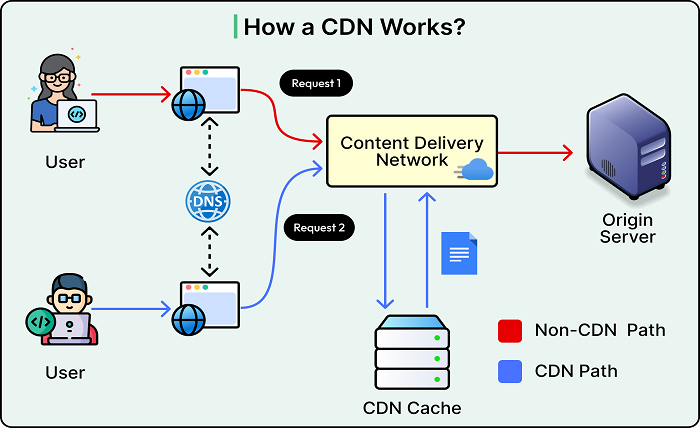
A content delivery network (CDN) is a geographically distributed system of servers that delivers web content to users based on their proximity to the nearest server node. When a user requests a webpage, a CDN routes that request to the closest available point of presence rather than the origin server, which may be located thousands of kilometres away. The reduction in physical distance between server and user is the primary mechanism through which CDNs reduce latency and accelerate page load times.
How CDN Architecture Works
A CDN consists of an origin server — where the website’s content is hosted — and a network of edge servers, also called points of presence (PoPs), distributed across multiple geographic regions. When a user requests a resource — an image, a CSS file, a JavaScript bundle, a video — the CDN’s DNS routing system directs the request to the nearest PoP. If that edge server has the requested resource in its cache, it serves the file directly. If not, it retrieves the file from the origin server, caches it locally, and serves it to the user. Subsequent requests for the same resource from users in that region are served from cache, with no round-trip to the origin.
Cache hit ratio — the percentage of requests served from edge cache rather than the origin — is the core performance metric. A well-configured CDN can achieve hit ratios above 90% for static assets, meaning most requests never reach the origin server. This reduces latency for users and bandwidth load on the origin infrastructure.
What CDNs Cache — and What They Don’t
CDNs are most effective for static assets — images, fonts, CSS, JavaScript, and pre-rendered HTML. Dynamic content — personalized pages, authenticated sessions, real-time data — is typically not cached because it varies by user or changes too frequently. Modern CDNs handle this distinction through cache-control directives, serving static assets from edge cache while passing dynamic requests to the origin.
| Content Type | CDN Cacheable? | Typical TTL |
| Images, fonts, icons | Yes — high cache efficiency | Days to weeks |
| CSS and JavaScript bundles | Yes — with cache-busting on deploy | Long — versioned filenames |
| HTML pages (static) | Yes — with short TTL | Minutes to hours |
| Authenticated pages | No — user-specific content | Not applicable |
| API responses (real-time) | Rarely — depends on data freshness | Seconds or bypass |
Latency, RTT, and Why Distance Costs Time
Network latency is measured in round-trip time (RTT) — the time it takes for a data packet to travel from the client to the server and back. RTT is constrained by the speed of light in fibre-optic cable, which imposes a physical minimum of approximately 1 millisecond per 100 kilometres. A user in Vancouver requesting content from an origin server in Frankfurt faces a minimum RTT of roughly 90ms before any processing begins. A CDN edge node in the same city as the user reduces that RTT to under 5ms for cached assets — an improvement that compounds across every resource a page loads.
For platforms where session quality depends on fast, consistent response times — online casinos, live dealer platforms, real-time gaming environments — CDN-backed delivery is not optional infrastructure. Players placing wagers on slot titles, navigating between game categories, or loading live dealer streams at https://spin.city/en benefit from edge-cached game assets, fast-loading deposit interfaces, and low-latency session continuity that keeps the playing experience fluid regardless of the user’s geographic location.
CDN Security Benefits Beyond Performance
CDNs provide DDoS protection as a consequence of their architecture — volumetric attacks are distributed across multiple PoPs rather than hitting a single server. Major providers — Cloudflare, Akamai, Fastly — add Web Application Firewall (WAF) rules, bot detection, TLS termination at the edge, and rate limiting — capabilities that matter for financial and gaming platforms handling sensitive transaction data.
Core CDN Metrics to Monitor in Production
Operators running CDN-backed platforms should track these metrics to assess whether the deployment is performing as expected:
- Cache hit ratio: target above 85% for static assets — below this suggests misconfigured TTL or cache-control headers.
- Origin offload percentage: the share of total bandwidth served from edge cache rather than origin — a high-value metric for cost and scalability.
- Time to First Byte (TTFB): measures server response time before content transfer begins — a CDN should consistently reduce this for cached resources.
- Error rate by PoP: sudden spikes in 5xx errors from specific edge locations indicate origin connectivity issues or misconfigured routing rules.
Choosing a CDN: What Actually Differentiates Providers
CDN selection involves trade-offs between network size, pricing, and feature set. Cloudflare offers one of the largest PoP networks with a generous free tier. Akamai is optimized for enterprise-scale traffic with strong SLAs. Fastly is differentiated by real-time cache purging — critical for platforms that need to invalidate content immediately on update. The right choice depends on traffic patterns, user geography, and whether edge computing is needed alongside basic delivery.