If you’ve ever grabbed a pencil, placed it on paper, and confidently thought, “This time I’ll draw it perfectly,” only to end up with something that looks more like an oval it’s not just you. Believe it or not, why humans can’t draw perfect circles isn’t about lack of skill or practice. It’s actually a fascinating trick of the brain that reveals just how complex our coordination and perception really are.
From artists to scientists, people have long been obsessed with the idea of perfection in shapes, especially circles. But here’s the fun twist: your brain doesn’t want you to draw a perfect circle. It prefers creative imperfection! That’s why this topic is so exciting. Understanding the why behind it can improve your accuracy, boost your creativity, and make your next attempt with the Draw a Perfect Circle Tool even more rewarding. Ready to uncover the brain’s secret? Let’s dive in!
The Curious Case of Why Humans Can’t Draw Perfect Circles
When you try to draw a circle freehand, your motor control, visual processing, and spatial awareness all work together. But even with perfect coordination, your brain struggles to create flawless curves. Why? Because it’s wired for efficiency, not perfection.
Human eyes constantly make micro adjustments, and our muscles naturally twitch tiny, involuntary movements that help with balance and reaction time but ruin geometric precision. According to neuroscience research, these micro errors are what make every hand drawn circle beautifully unique.
The fun part? This imperfection gives every artist their signature style. So the next time you draw a not so perfect circle, remember it’s not a failure; it’s your brain’s creative fingerprint.
Whether you use Draw a Perfect Square, practice with Draw a Straight Line, experiment on the Mirror Drawing Tool, or race the Circle Speed Challenge Timer, you’ll love our related tutorial that helps master hand-eye coordination.
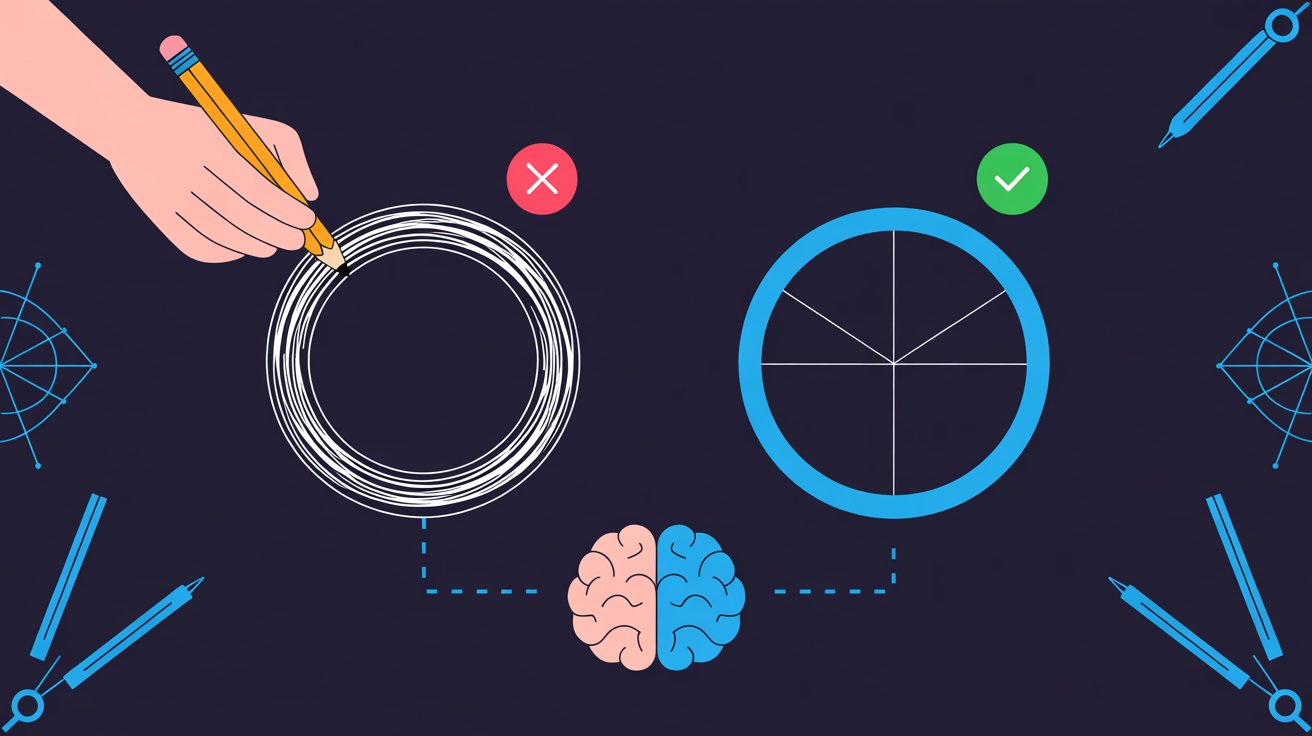
The Brain Trick Behind the Circle Challenge
Here’s where psychology gets interesting. When your brain processes shapes, it doesn’t “see” the entire circle at once it builds it piece by piece. Each small arc is drawn based on where your hand thinks it should go, not where it actually is.
That’s the brain trick: perception versus motion. While your eyes and hands work in sync, there’s a split second delay that causes slight deviations. Scientists call this a neural lag, a gap between intention and action.
A study from the University of Tokyo (2024) found that even trained artists show a consistent margin of error of up to 3.2% when drawing circles freehand. That means even the pros can’t beat biology!
Geometry Meets Psychology: Why Imperfection Is Perfect
In geometry, a perfect circle has a constant radius at every point. But in psychology, perfection doesn’t always mean better. Our brains actually enjoy small variations. They trigger curiosity and satisfaction, two powerful motivators behind creativity.
When you attempt the circle drawing challenge, your brain enters a fun state of focused play. You’re balancing control with spontaneity, an act similar to meditation. This balance stimulates the dopamine reward system, making the experience enjoyable and encouraging repetition.
So yes, the reason why humans can’t draw perfect circles is scientific but it’s also artistic. The tiny “mistakes” are what make it beautiful, memorable, and truly human.
My Funny Circle Drawing Experience (and What I Learned)
When I first tried the Draw a Perfect Circle Tool, I was convinced I’d nail it on the first go. Spoiler alert: I didn’t. My circle looked like a potato wearing a halo.
But after a few tries, I started noticing patterns. I was rushing the top arc and gripping my mouse too tightly. Once I relaxed and focused on rhythm rather than speed, my score shot up from 47% to 83%!
Lesson learned: perfection isn’t the goal consistency is. The more you practice, the more your brain adapts. It’s like training a muscle; over time, you’ll see smoother motion and sharper focus.
Pro tip: Try drawing smaller circles first, then gradually go bigger. It trains your spatial precision and helps your hand memorize circular motion.
Expert Insight: Why the Brain Prefers Imperfection
“Freehand drawing exercises like circles are a perfect window into how the brain balances precision and creativity,” says Dr. Eliza Moore, a cognitive psychologist at the University of Cambridge.
“They reveal our brain’s incredible adaptability and its comfort with imperfection.”
Artists agree. Renowned sketch instructor James Nolan teaches his students that chasing perfect geometry kills flow. “The goal isn’t symmetry, it’s energy,” he says. “A lively, slightly uneven circle feels more human.”
This harmony between science and art shows why imperfection isn’t a flaw, it’s the brain’s way of adding personality.
Real World Example: The Perfectly Imperfect Circles of Artists
Think of Giotto di Bondone, the medieval painter who famously impressed the Pope by drawing a perfect circle freehand. Even then, “perfect” was subjective; it only looked perfect because it showed control and confidence.
Modern digital artists face the same challenge. In animation studios like Pixar, hand drawn circles are intentionally imperfect to make motion feel alive. A computer perfect circle feels mechanical; a human drawn one feels natural.
That’s exactly why the Draw a Perfect Circle Challenge has become such a viral test online it combines skill, creativity, and a touch of humor.
Interactive Fun: Test Yourself With the Circle Tool
Want to see how close you can get to perfection? Head over to the Draw a Perfect Circle Tool and test your skills right now.
- Aim for 85% or higher accuracy.
- Challenge your friends to beat your score.
- Share screenshots on social media using the hashtag #CircleChallenge2025.
Every round helps you improve your hand eye coordination and spatial accuracy and it’s ridiculously fun. The game also gives you instant feedback, so you can track your progress over time.
Can you beat 90%? The only way to find out is to try it now!
Tips to Draw Better Circles (Backed by Science)
- Relax your wrist. Tension creates uneven arcs.
- Draw from your shoulder, not just your hand. It gives smoother curves.
- Use rhythm, not speed. Think of it like dancing with your pencil.
- Keep your eyes on the midpoint. It stabilizes your circular path.
- Practice daily with the circle drawing tool for micro improvement.
Each of these habits trains your motor memory, gradually closing the gap between what your brain intends and what your hand creates.
Conclusion: The Circle of Human Creativity
So, why humans can’t draw perfect circles isn’t a flaw, it’s a feature of our incredible brains. We’re wired for expression, not perfection. Each wobble in your circle tells a story of balance, motion, and focus.
Next time you take the circle challenge, celebrate every imperfection as proof of being uniquely human. Remember, even the most advanced AI tools can’t replicate the personality behind your lines.
✅ Try the Draw a Perfect Circle Tool now, share your score, and see if you can break your personal record.
Want more fun shape challenges and brain tricks? Bookmark our blog and explore the next circle based challenge today!
FAQs About why humans can’t draw perfect circles
Why do humans struggle to draw perfect circles?
Because our brains and muscles make micro adjustments for balance and speed, creating natural deviations. It’s biology, not lack of talent.
Can training help improve circle accuracy?
Yes! Regular practice using the Draw a Perfect Circle Tool enhances motor coordination and visual focus over time.
Is anyone able to draw a perfect circle freehand?
Even top artists can’t achieve geometric perfection, but they can create circles that appear perfect due to skill and confidence.
Why does drawing circles feel satisfying?
It engages your visual motor system and releases dopamine making it both relaxing and rewarding.
How can I get better at circle challenges?
Relax your wrist, draw slowly, and practice with the online tool daily. Aim to improve your score step by step.
You Can Visit Our More Articles:
- Master Brain Hand Coordination Circle Drawing in Minutes!
- Take the Circle Drawing Personality Test Challenge!
- 5 Surprising Benefits of Drawing Circles for Focus
- The Psychology of Circles: Why They Calm Your Mind
- The Fun Science Behind Circle Drawing Stress Relief
- How Circles for Better Handwriting Boost Focus Fast
- How Neurological Studies Circle Accuracy Changed Drawing Games
- Right Brain vs Left Brain Drawing: Who Wins the Circle Test?
- How Circle Drawing Meditation Calms Your Brain Fast
- Why Children Draw Circles First The Psychology Explained
- Personality Traits Circle Drawing: The Fun Mind Test!
- Circle Drawing ADHD Test: Try This Fun Hack!
- Why circle drawing cognitive therapy Works Fast
- The Psychology Behind why circles are pleasing