Ever wondered how the Ancient Greeks could carve out architectural wonders with such perfect symmetry? It wasn’t magic, it was geometry, and more specifically, their deep fascination with the circle. Long before modern compasses or the internet’s “Draw a Perfect Circle Challenge,” ancient thinkers were already obsessed with that flawless, never ending curve.
In a world without digital tools or laser guides, the ancient Greek circle study was both science and art. From temple domes to astronomical diagrams, the circle symbolized perfection, balance, and divine proportion. And just like we test our skills on today’s circle drawing tool, Greek scholars pushed their creativity, precision, and patience to the limit all in the name of geometric mastery.
Why Circles Mattered So Much in Ancient Greece
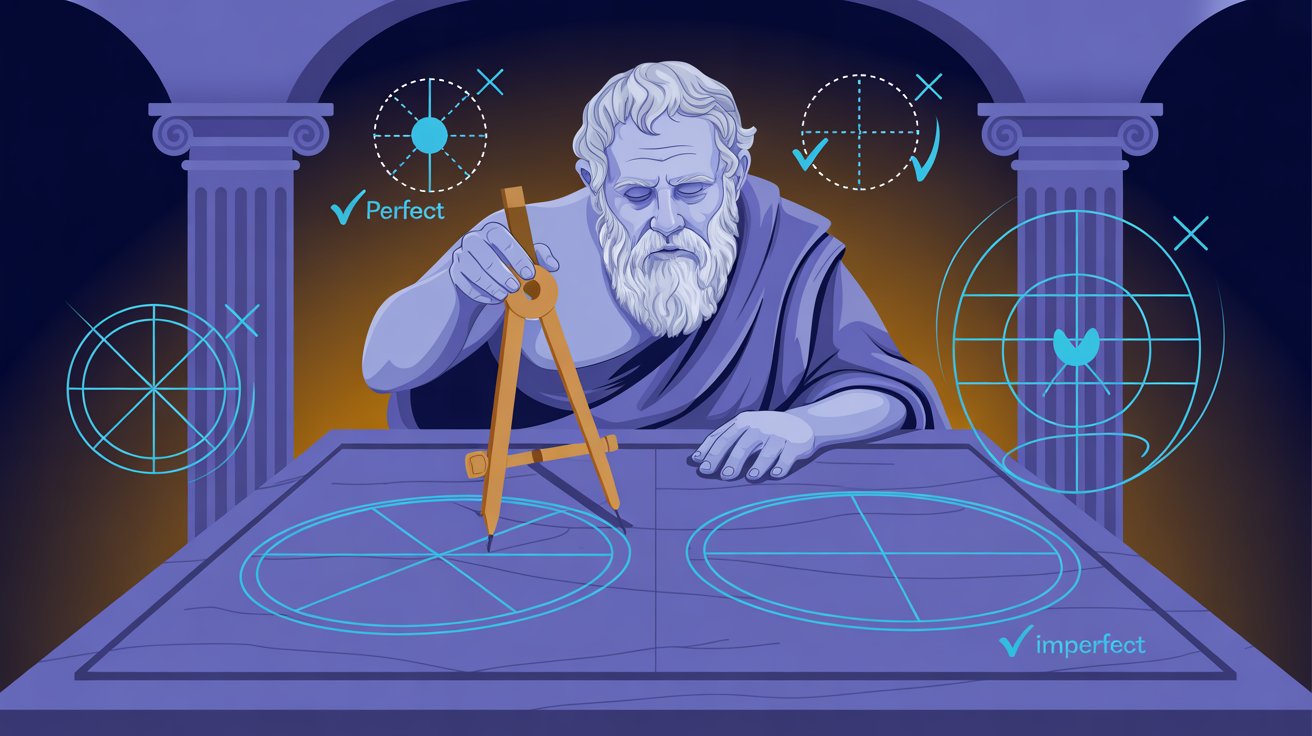
To the Greeks, a circle wasn’t just a shape it was the embodiment of perfection and infinity. Philosophers like Plato believed that geometry was the language of the universe. The circle, being flawless and continuous, represented the divine order of nature.
Greek mathematicians such as Euclid and Archimedes studied circles to understand everything from planetary motion to architectural stability. Their work became the foundation of geometry, influencing modern design, art, and even psychology where circles still represent unity and wholeness.
Think about it: every time you try to draw a circle freehand, you’re echoing the same challenge that fascinated the brightest minds of ancient times.
Start with Draw a Perfect Square, level up using Draw a Straight Line, refine precision on the Mirror Drawing Tool, and push limits with the Circle Speed Challenge Timer then visit our advanced accuracy tips post to grow even faster.
The Masters Behind the Circle Obsession
1. Euclid The Father of Geometry
Euclid’s Elements remains one of the most influential works in mathematical history. He formalized the rules of geometry, defining the properties of circles, chords, tangents, and angles. His methods are still taught in schools today.
2. Archimedes The Genius of Measurement
Archimedes pushed circle studies even further. He was the first to calculate pi (π) with high accuracy, understanding that the ratio between a circle’s circumference and its diameter is constant. His love for circles led to inventions like the Archimedean spiral, a shape found everywhere from galaxies to fingerprints.
3. Apollonius of Perga The Conic King
Apollonius explored how circles transform into ellipses, parabolas, and hyperbolas the same principles later used in satellite orbits and physics. Without his insights, space exploration and advanced optics might look very different today.
Fun Fact: Circles Were Sacred Symbols
In Greek mythology and religion, the circle stood for eternity, balance, and cosmic order. Temples like the Tholos of Delphi and Epidauros incorporated circular layouts to honor gods associated with perfection and harmony. Even in philosophy, circles represented the cycle of life no beginning, no end.
How Ancient Greeks Practiced Circle Drawing
You might imagine them with compasses and chisels, but early Greek geometers relied on strings, stakes, and pure skill. Here’s how they perfected their curves:
- The Rope Method: They tied a rope to a fixed point (the “center”) and drew around it to form a perfect curve.
- The Hand Technique: Using only the wrist and elbow as pivots, they trained themselves to keep the motion smooth much like how you practice with the Draw a Perfect Circle Tool today!
- Symmetry Exercises: Artists and architects repeated circular patterns to improve muscle memory and visual accuracy.
Their approach wasn’t just technical, it was meditative, much like today’s mindfulness drawing exercises.
My Fun Circle Challenge Experience
I once tried drawing a perfect circle during a friendly “geometry game night.” My first attempt looked more like a potato than a planet. But after a few tries (and some serious laughter), I realized something: the trick isn’t in having a steady hand it’s in training your motion.
Here’s a simple trick I learned: keep your eyes fixed on the midpoint, not the line. This keeps your motion smooth and centered the same principle the Greeks mastered centuries ago!
What Experts Say About Circle Learning
According to Dr. Helen Morris, a geometry educator at the University of Athens,
“The Ancient Greeks didn’t study circles just to calculate, they studied them to think better. Geometry trained their logic and creativity side by side.”
Modern psychologists agree. A 2024 University of Cambridge study found that drawing geometric shapes boosts focus by up to 20% especially circles, since they engage both hemispheres of the brain.
So when you test yourself on the Draw a Perfect Circle Tool, you’re not only improving hand eye coordination you’re literally training your mind like an ancient scholar!
Try the Circle Challenge Greek Style!
Here’s your mission:
- Go to the Draw a Perfect Circle Tool.
- Try drawing a perfect circle without lifting your hand.
- Aim for at least 85% accuracy that’s your “Euclid score.”
- Challenge your friends and see who can beat Archimedes’ level (90%+).
Each score gives you a taste of what the ancient Greek circle study felt like precision, patience, and pure satisfaction.
The Psychology of Circle Drawing
Why does drawing a simple circle feel so satisfying? Psychologists suggest it’s because circles trigger a sense of completion and calm in the brain. Circular motions are associated with balance, and the visual symmetry gives instant feedback to our sense of order.
In ancient Greece, philosophers used circles to meditate on perfection, a tradition that modern mindfulness artists still practice today. When you draw a perfect circle, you’re not just testing geometry; you’re touching a piece of ancient wisdom.
How You Can Learn from the Greeks (and Have Fun)
- Start small: Practice with circles of different sizes.
- Use rhythm: Draw to the beat of music for smoother motion.
- Challenge yourself: Try drawing with your non dominant hand.
- Track progress: Use the online circle accuracy tool to see improvement over time.
Every circle you draw is a step toward mastering patience and precision something both ancient philosophers and digital artists would appreciate!
Conclusion: The Circle of Learning Never Ends
The ancient Greek circle study wasn’t just about math, it was a celebration of curiosity, beauty, and mastery. Today, with fun tools like the Draw a Perfect Circle Challenge, you can relive that same joy of discovery.
Whether you’re a student, an artist, or someone just looking for a fun skill to brag about online, the circle is your perfect teacher.
👉 Try the tool now, share your best score, and see how close you can get to geometric perfection. The Greeks would definitely approve!
FAQs About Ancient Greek Circle Study
What was the purpose of circle studies in Ancient Greece?
The Greeks studied circles to understand geometry, architecture, and the natural world. It symbolized perfection and harmony in both science and philosophy.
Who were the main contributors to ancient circle geometry?
Euclid, Archimedes, and Apollonius were the pioneers. Their circle theories still shape modern mathematics and design.
How did Ancient Greeks draw circles without modern tools?
They used ropes, pegs, and simple measurements. Their techniques emphasized control, focus, and visual estimation.
Why do circles represent perfection in Greek culture?
Because of their symmetry and endless form, circles symbolized divine balance and eternal order ideals deeply rooted in Greek philosophy.
Can practicing circle drawing improve focus and creativity?
Absolutely! Studies show that repetitive geometric drawing improves concentration, spatial memory, and creativity, making it both fun and beneficial.
You Can Visit Our More Articles:
- The Geometry of a Perfect Circle: Can You Master It?
- Why Circles in Mathematics Are So Addictive
- 5 Fun Facts About the Perfect Shape in Geometry Circle
- Pi and Circle Connection Explained in 30 Seconds!
- The Hidden Geometry Behind Circles in Nature
- Circle Symmetry in Design: The Secret to Perfect Art
- 5 Mind Blowing Facts About the Golden Ratio and Circles
- The Hidden Minds: Mathematicians Who Studied Circles
- Teaching Geometry with Circles: A Creative Twist
- Why Circles in Engineering and Architecture Rule Design
- Circle vs Ellipse Showdown: Who Wins the Shape Game?
- How Circles in Astronomy Shape Our Universe
- Why Circles in Logos and Branding Capture Attention Fast
- How to Draw a Straight Line Without a Ruler Challenge!
- The Easiest Way to Draw a Straight Line by Hand No Tools Needed!
- Test Your Freehand Accuracy Online Can You Win?
- Circle Geometry Formulas Made Easy and Fun
- Master Geometry Fast with the Circle of Apollonius
- Can You Spot the Real Life Perfect Circles Challenge?
- Can You Perfectly Draw Circles Without Tools?
- Why Circles in Islamic Art Feel So Perfect