Mathematics and fun don’t always show up in the same sentence until you start talking about circles. These perfect, infinite shapes have fascinated mathematicians, artists, and casual doodlers for thousands of years. From ancient geometry to modern day viral circle drawing challenges, there’s something irresistibly satisfying about trying to master the perfect curve.
But why exactly are circles in mathematics so addictive? Maybe it’s their flawless symmetry. Maybe it’s how a single continuous line can represent infinity, unity, and perfection all at once. Or maybe, just maybe, it’s the thrill of proving your hand is as steady as a compass. Whether you’re a student exploring geometry or someone who loves friendly online challenges, circles seem to pull everyone into their orbit literally! Want to improve your accuracy? Check out our full guide on the Draw a Perfect Circle Tool to explore more tips and related challenges.
The Magical Pull of the Perfect Circle
There’s something deeply satisfying about drawing or understanding a circle. Its balance and perfection appeal to both the logical and creative sides of the brain. In geometry, circles are used to study pi (π), radius, diameter, and circumference fundamental ideas that explain how the world fits together. But there’s also a hidden psychological layer: the human mind craves symmetry.
Studies from the Cognitive Science Society show that people rate symmetrical shapes as more beautiful, calming, and “complete.” This might explain why we love circles and our brains naturally find them rewarding. And when a simple online circle drawing game challenges us to create one freehand, it feels like we’re taking part in an ancient puzzle, one that’s both fun and deeply human.
Whether you use Draw a Perfect Square, practice with Draw a Straight Line, experiment on the Mirror Drawing Tool, or race the Circle Speed Challenge Timer, you’ll love our related tutorial that helps master hand-eye coordination.
The Geometry Behind the Addiction
The math behind circles is fascinating. Every circle is defined by just one constant its radius yet it can model everything from planetary motion to raindrops. That simplicity hides immense power.
Here’s a fun way to see it:
| Mathematical Term | What It Means | Why It Feels Magical |
| Radius | Distance from center to edge | The secret that defines every circle |
| Diameter | Twice the radius | The measure of completeness |
| Pi (π) | Ratio of circumference to diameter | The never ending number that defines circular beauty |
| Circumference | The distance around a circle | The “journey” your pen takes in one loop |
Learning these concepts isn’t just about solving equations, it’s about seeing beauty in precision. That’s why mastering circles in mathematics feels so fulfilling. It blends curiosity, challenge, and creativity all in one loop.
A Funny Circle Drawing Moment (Personal Touch Block)
Let’s be honest, everyone thinks they can draw a perfect circle… until they actually try.
The first time I used the Draw a Perfect Circle Tool, I was confident. I thought, “How hard can it be?” My first attempt scored 43% accuracy, not exactly Picasso level precision. I laughed out loud. But after trying again (and again), I noticed a pattern: slowing down improved control, and keeping my eyes on the center point worked better than focusing on the outline.
Lesson learned? The circle challenge isn’t about perfection. It’s about patience, rhythm, and focus skills that actually help in math and beyond. And yes, after a dozen tries, I finally hit 88% accuracy. Still chasing that 90%!
Expert Insight: Why Circles Keep Us Hooked
According to Dr. Elena Morris, a cognitive psychologist at Stanford, “Circles stimulate both precision and creativity, a rare combination that keeps the brain engaged. The act of drawing one perfectly activates pattern recognition, hand eye coordination, and satisfaction loops.”
That’s why activities like circle drawing tests are used in design schools, math classrooms, and even mindfulness exercises. Circles combine order and flow, a perfect metaphor for balance.
And when geometry teachers challenge students to draw circles without tools, it’s not just a game; it’s a lesson in mathematical intuition and spatial intelligence.
Real World Example: From Da Vinci to Digital Circles
Leonardo da Vinci once said, “Simplicity is the ultimate sophistication.” He studied circles endlessly, believing they reflected the perfect proportions of nature. Centuries later, digital designers use the same geometry to create app icons, logos, and interfaces all based on circular symmetry.
In fact, Apple’s logo, Olympic rings, and even camera lenses are all designed using mathematical circle ratios. The same geometric perfection that fascinates mathematicians now drives design, technology, and even social media aesthetics.
So when you draw a near perfect circle online, you’re continuing a tradition that stretches from ancient Greece to modern Silicon Valley.
The Challenge: Can You Draw a Perfect Circle?
Here’s where the fun really begins. Want to test your geometry instincts? Try the Draw a Perfect Circle Tool on our site.
- Click and start drawing your best circle freehand.
- See your accuracy score instantly (mine was 43% at first ouch!).
- Try again to improve your symmetry and steadiness.
- Share your results online and challenge your friends to beat your score.
It’s more than just a game; it’s a way to experience circles in mathematics through creativity and muscle memory. Plus, you’ll notice something amazing: the more you play, the more you start seeing circles everywhere in wheels, ripples, and patterns around you.
Can you beat 85%? Try now and find out!
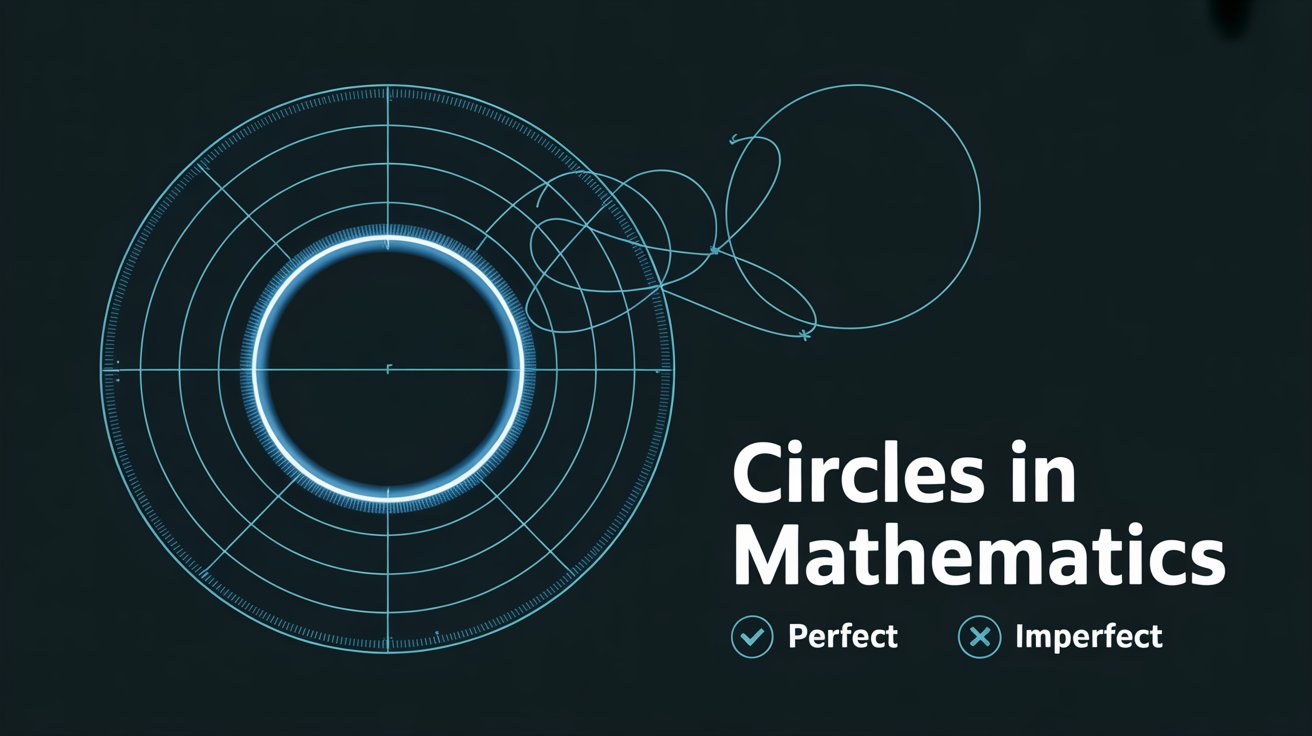
Why Circles Inspire Curiosity and Calm
Circles aren’t just mathematical; they’re emotional. In psychology, circular shapes symbolize harmony, wholeness, and focus. Meditation exercises often use mandalas with complex circular patterns to promote relaxation.
When we engage with circles in mathematics, our brains respond positively because the process feels orderly and complete. It’s like solving a puzzle that always fits perfectly. That’s part of why circle based challenges go viral on TikTok and Instagram; they trigger satisfaction, competitiveness, and a sense of flow all at once.
Pro Tips for Boosting Your Circle Accuracy
- Keep your wrist loose. Stiffness breaks the curve.
- Draw in one continuous motion. Don’t stop midway.
- Focus on the center point, not the line.
- Practice on different sizes. Larger circles reveal small mistakes.
- Use rhythm like a dance. Smooth movement leads to smoother curves.
Each improvement brings a little dopamine rush and that’s what makes circles in mathematics truly addictive.
Conclusion: The Perfect Shape of Fun
From geometry class to digital design, circles in mathematics have always symbolized perfection and beauty. They connect logic with creativity and transform simple drawing into an art form.
So next time you open the Draw a Perfect Circle Tool, remember it’s not just about accuracy. It’s about curiosity, focus, and joy. Whether you hit 60% or 95%, every circle you draw improves your coordination and appreciation for geometry’s simplest yet most profound shape.
Try our tool now, share your score, and keep exploring more fun challenges at Draw a Perfect Circle Tool. Who knows your next circle might be the perfect one!
FAQs About Circles in Mathematics
Why are circles so important in mathematics?
Because they connect geometry, algebra, and physics. Circles in mathematics represent balance, motion, and infinite symmetry all fundamental to how we understand space and structure.
Why do people love drawing circles online?
It’s a mix of fun, precision, and challenge. The instant feedback from the circle drawing tool makes it addictive; you always want to beat your previous score!
Are circles used in real life designs?
Absolutely. Circles appear in architecture, logos, lenses, and even traffic systems. Designers love them for their perfect symmetry and natural visual harmony.
How can I draw a better circle by hand?
Relax your hand, move steadily, and focus on smooth motion rather than control. Practice regularly with the circle challenge tool to boost accuracy.
What does a circle symbolize in psychology?
It represents unity, balance, and wholeness. That’s why circular patterns are used in meditation, design, and art therapy; they naturally calm and focus the mind.
You Can Visit Our More Articles:
- The Geometry of a Perfect Circle: Can You Master It?
- What the Ancient Greek Circle Study Can Teach You
- 5 Fun Facts About the Perfect Shape in Geometry Circle
- Pi and Circle Connection Explained in 30 Seconds!
- The Hidden Geometry Behind Circles in Nature
- Circle Symmetry in Design: The Secret to Perfect Art
- 5 Mind Blowing Facts About the Golden Ratio and Circles
- The Hidden Minds: Mathematicians Who Studied Circles
- Teaching Geometry with Circles: A Creative Twist
- Why Circles in Engineering and Architecture Rule Design
- Circle vs Ellipse Showdown: Who Wins the Shape Game?
- How Circles in Astronomy Shape Our Universe
- Why Circles in Logos and Branding Capture Attention Fast
- How to Draw a Straight Line Without a Ruler Challenge!
- The Easiest Way to Draw a Straight Line by Hand No Tools Needed!
- Test Your Freehand Accuracy Online Can You Win?
- Circle Geometry Formulas Made Easy and Fun
- Master Geometry Fast with the Circle of Apollonius
- Can You Spot the Real Life Perfect Circles Challenge?
- Can You Perfectly Draw Circles Without Tools?
- Why Circles in Islamic Art Feel So Perfect